

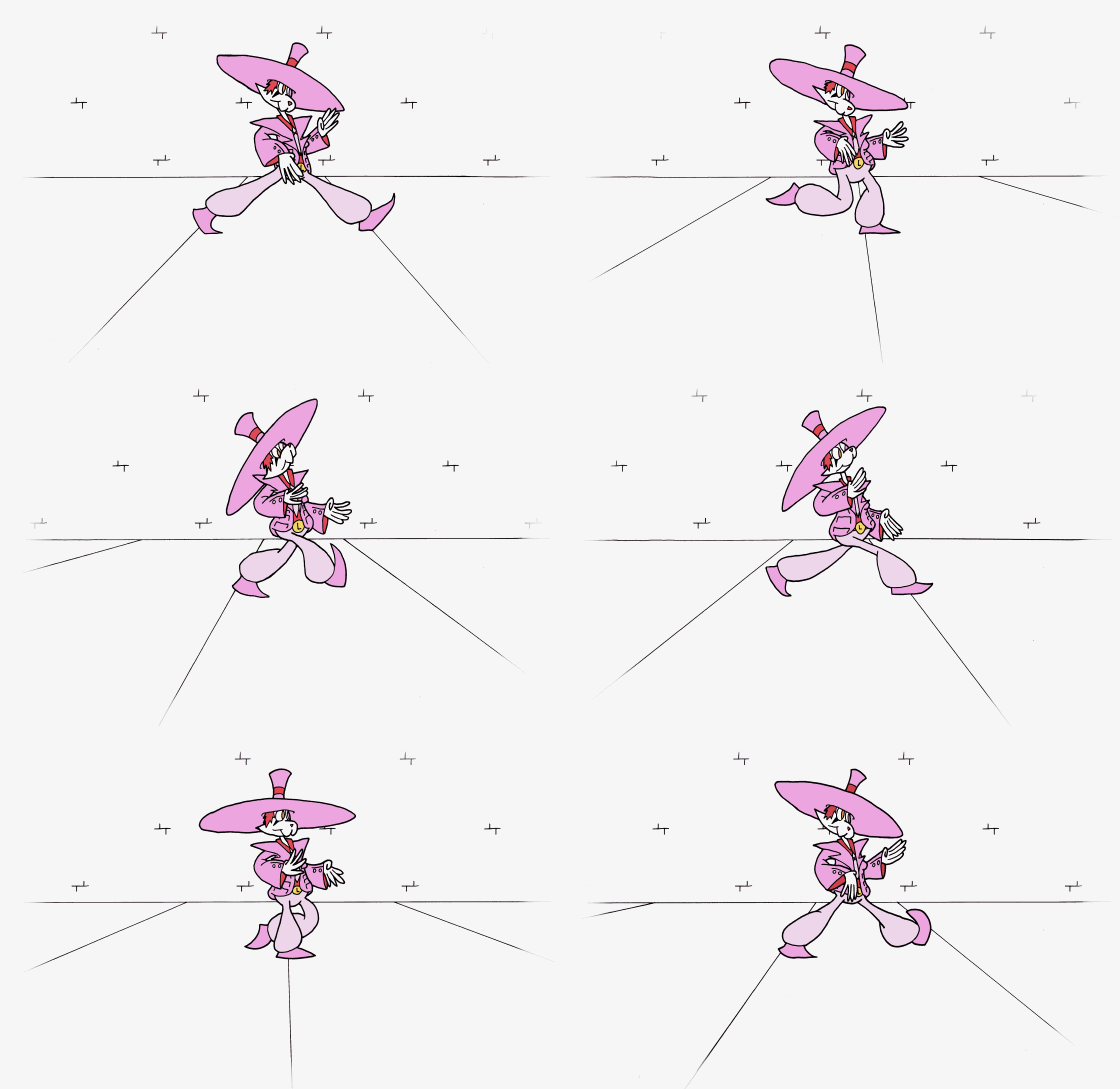

I’ve mentioned this, hmm, a couple of times on this site, but my main goal with the Lizzie Smithson/MegaCincinnati project, being brutally honest, is simply to remake Sly Cooper. Or specifically, the pickpocketing mechanic in Sly Cooper, with special attention to how it’s implemented in episode 3 of Sly 3. I consider Episode 3 of Sly 3 to be the absolute peak of game design as an artform, and Lizzie Smithson is my sort of tribute to everything I like about it.
I’m not talking about the story and the missions (I mean, they’re fine). I like those levels for the pickpocketing. I can, and have, spent hundreds of hours picking pockets in the hub area of that level. It never gets old! Even after all these years, every once in a while the game’s interlocking systems knock together in a manner that I’ve never seen before, and the whole time I’m just running around grinding for coins in a level that seems to possess infinite multitudes. It’s amazing!
So Lizzie Smithson is my attempt to capture some of that magic. Always in a more minimalistic form than Sly Cooper ever possessed... not out of a taste for minimalism, but out of necessity due to my being a solo programmer and artist compared to Sucker Punch Production’s dozen plus team and million dollar budget. Lizzie Smithson is basically the pickpocketing part of Sly Cooper... but *smaller*.
The scope difference has resulted in some strange deviations from Sly’s formula. In particular, with a lot of my pickpocketing games (One Armed Robbery, Endless Pickpocketing), a significant difference is the *pacing* of how often the player scores a point/picks a pocket/gets rewarded for their understanding of the mechanics. In a game like Endless Pickpocketing, this happens a few dozen times a minute. In One Armed Robbery, it happens every few turns. In Sly Cooper, it happens occasionally, but not so frequently that there’s never a dull moment.
Sometimes Sly Cooper is boring!
The fact that Sly Cooper is sometimes boring is part of the reason Sly Cooper is better than Lizzie Smithson!
I mean that!
The game at the top of this page, Slow and Lucky, is attempting to recreate the “boring” parts of Sly Cooper. There’s a good chance you don’t find it fun. I won’t say for the moment whether *I* find it fun, but I’ve conducted some analysis, which I will now reveal via text essay. Hopefully by the end of it, you will understand why I designed this game the way I did. If not, hopefully these numbers will be at least vaguely interesting to you.
If you look at big budget, open world games, you don’t usually come across a new challenge every five seconds. A lot of the gameplay of open world games involves holding forward on the control stick and waiting for something to happen! In some games, you could be holding forward on the control stick for longer periods of time than you’re doing anything else!
The developers of The Witcher 3 concocted a “Rule of Thirty Seconds”, meaning that the player should get something, or see something that piques their interest, every 30 seconds while exploring the game world. I am about to prove that CD Projekt Red were not the first or the best to come up with this idea, so let’s take a look at Sly 3: Honor Among Thieves, from a DATA ANALYSIST’s perspective.
Years ago, I recorded this youtube video of myself picking pockets in Episode 3 of Sly 3. We’ll use that as a reference point, and say that it represents a standard hour long play session (my playing style is surprisingly suboptimal, which is kind of embarrassing). I watched the whole video, and recorded my actions on a blue yeti microphone. Every time Sly picked a pocket, I would slap the top of the microphone, in order to produce a clearly visible waveform in the Audacity file I could look at later. This gives me an extremely specific view of how many times in my playthrough Sly Cooper picked somebody’s pocket.
Here’s a graph showing each timestamp on each robbery (with a few missing ones that I will explain in a moment):
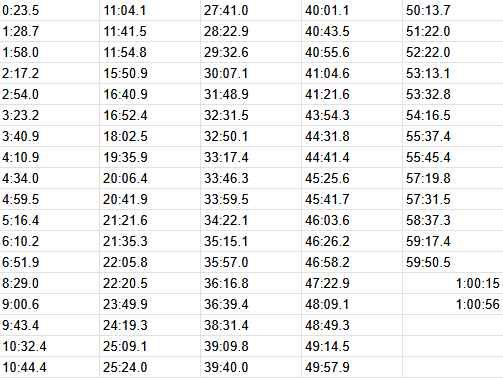
If you were to count these, you would see that I recorded 87 separate robberies over the course of my playthrough. That’s 87 robberies in an hour, right?
Well, not so fast. If you watch that video yourself, there’s a couple of times during my playthrough where I take a break from picking pockets, and start smashing crates for health. For whatever reason, when I recorded that video, I was really nervous about the possibility of Sly dying during the footage, so several times I ran around farming health for a few minutes until Sly was all healed up. I don’t know why I was so nervous about this. I guess I was worried about embarrassing myself with my poor gamer skills.
So, while I was recording in Audacity, I made a point to slap the microphone EIGHT TIMES each time I realized I was about to heal myself. Then, once Sly resumed his pocket hunt, I would slap the mic ANOTHER EIGHT TIMES to alert my future self to resume taking notes.
To be clear, I don’t consider the time I spent healing to be relevant to the discussion of Sly Cooper’s pacing. I would consider that to be... a sidequest at best. I am only interested in Sly Cooper’s rewards scheduling, not its punishment scheduling.
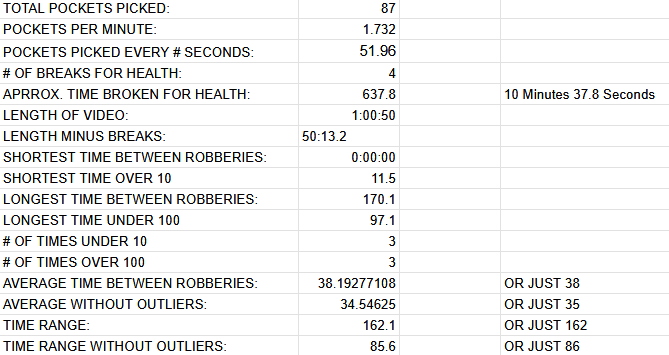
With that in mind, my notes tell me that over the course of my playthrough, I took breaks to heal exactly 4 times, removing 10 minutes and 37.8 seconds from the relevant material of the video. This brings the sections of the video we are about to study to a solid 50 minutes and 13.2 seconds, give or take.
So! In 50 minutes and 13.2 seconds, Sly Cooper picked 87 pockets. That’s a rate per minute of 1.732. So, Sly Cooper appears to pick a pocket roughly every 51.96 seconds? Does the data support this?
Well, here’s our next chart. It’s a list of the amount of time that elapsed in between each pickpocket attempt, measured in milliseconds. There’s some margin for error here, a couple times when I recorded I didn’t slap the mic immediately, so those initial times might not be absolutely perfect, but we’ll use this to determine roughly how long each robbery attempt took:
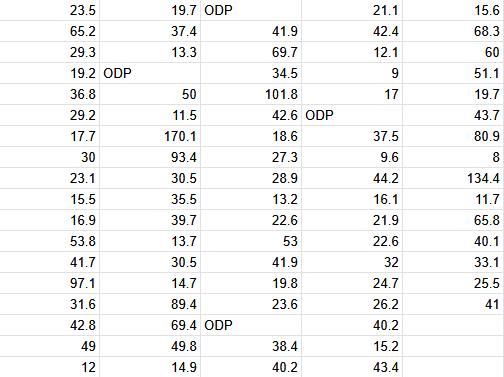
(ODP stands for “Outlying Data Point” and each one represent a section where I took a break to farm health, so those points aren’t useful to us.)
Looking at this second chart, the 51.96 second rule clearly does not hold. Only 13 robberies out of all 87 took longer than that, or about 15%. Many of them took *substantially* less time, and a handful of them took much longer. Can we weed out some outliers? After all, I’ve already mentioned this isn’t really optimal playing–maybe the outliers represent poor play?
3 of the pickpocketing attempts took over a hundred seconds. One of those attempts took almost 3 minutes! That 51.96 estimate clearly isn’t quite accurate. So let’s take an average of how long each attempt took and look at that.
The average time taken for each robbery was: 38.19277108. This is awfully close to The Witcher 3’s 30 second rule! Let’s remove those over 100 second outliers, and let’s also take out times that were suspiciously low–a couple times during this playthrough, I actually stumbled upon two pickpocketable guards right next to each other, but we can hardly count that as normal play. According to my chart, this happened 3 times, so let’s average out the time minus the outliers:
The average time, minus the outliers, is: 34.54625. Only 4.54625 seconds over the 30 second rule! That’s within the margin of error for this game to be considered as following the 30 second rule! So we can conclude: The Witcher 3 totally ripped off the pacing of their game from a 2005 cereal box mascot platformer. You didn’t invent SHIT, CD Projekt Red!
Now, let’s apply this to the game I showed you on this page. The 30 second rule is all well and good, but Sly Cooper ALSO follows the randomized rewards scheduling one would associate with the original Skinner Box experiments. We can debate the ethics of the Skinner Box experiments another time, but Sly Cooper seems to follow them, and thus so must we. Sly does this, obviously, by randomizing the rewards you get with each successful pickpocket. Each successful robbery can net you anywhere from 24 to 140 coins, according to the fan Wiki’s loot table.
BUT Sly 3 also randomizes the amount of time spent on each robbery, as we’ve discussed! There’s NEVER an exact 34.54625 second break in between each robbery. Sometimes it’s 20 seconds, sometimes it’s 40, occasionally it’s just over 10. So what’s the variance?
Well, the shortest amount of time spent on any of those robberies is 8 seconds. If we look at the number of times spent over 10 seconds (removing the 3 outliers), the shortest amount of time would be 11.5 seconds. We’ll do the same for the longest amount of time taken–the longest amount overall is 170.1 seconds, the longer time UNDER 100 seconds was 97.1 seconds.
Therefore! We can explain Sly Cooper’s pacing thusly, based on this video footage:
The average time spent between each successful pickpocket in Sly 3 is: 34.54625 seconds.
The minimum time: 11.5 seconds.
The maximum time: 97.1 seconds.
The variance between the time taken: 85.6 seconds (or 162.1 seconds counting outliers).
Here’s a chart of the important data we’ve collected:
So that’s everything we need to recreate this... right?
WRONG! Here’s some more data for you:
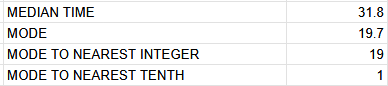
Basic statistics tells us that the average is not the whole story! When we analyze this data further using Google Sheets’ algorithms, we can see that the exact middle length of all the pickpocket times was just over 30 seconds, giving us an exact abidement of the 30 second rule!
BUT the MODE was 19 seconds! The majority of pickpocket times were lower than that, and it’s a handful of unusually high outliers that pushed the mean and median up!
SO. We need to reflect all of this in the game at the top of the page!
My initial attempt to time these robbery attempts was to simply put a minimum time of Sly’s minimum time, and a maximum time of Sly’s maximum time. This gave the average time of my own game an amount equal to the average time of Sly, but the modal time was way off. That wouldn’t do! We need to fiddle with these numbers some more!
So I reduced the maximum time the game would allow between targets to just 26.5 seconds, and ADDED additional code that would add an additional 60 seconds 33% of the time! That got it almost right, but it was still a bit off... So I rewrote the code to, 33% of the time, add 36.05 second, and, 12.5% of the time, double that added amount by 2! So how did that work out? Let’s see some numbers!
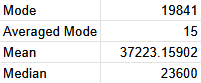
Mode is 19.8 seconds, averaged to 15 seconds counting the times to the nearest second, about 4 seconds off!
Median is 23.6 seconds, about 8 seconds off... not perfect, but let’s keep looking!
Mean is 37.2 seconds (the numbers in these graphs are in milliseconds by the way, hence the odd count there)... only 2.7 seconds off! Wow!
Do these numbers seem odd to you? Well, you don’t have to take my word for it. Click the button below, and this page will log a record of how long it takes for each pickpocket opportunity to elapse. You can use this to do the math yourself, if you want.
So here are some thoughts. Several times during this project, I found myself with the temptation to editorialize the game at the top of the page. The 30 second rule works well for open world games, but it’s frustratingly slow for something like this... I spent a lot of time wondering about whether I shouldn’t fudge these numbers more, and make the game a little bit faster paced. The problem is that if this game makes no attempt to be faithful, its raison d’etre is gone... there’s no reason to make this thing at all. So I have to stay a LITTLE faithful, BUT...
Something that needs to be mentioned is that this game, by its nature, requires some editorializing. I only have 50 minutes worth of footage of Sly Cooper to go off of... I’m sorry, it was too much work to capture more... and there’s a lot of room for errors in the footage I captured. I played non-optimally, I made mistakes, a lot of the way I DO play is rather different from the mainstream experience, and the level itself is a bit more challenging than is the norm for this series.
SO.
So.
I think it’s alright if I fudge these numbers a little bit. The average and the mode are pretty close! And the median is only slightly off (possibly within the margin of error? I’m not sure). So I declare that this game is, by my standards, a pretty close approximation of the experience of grinding for coins in Sly Cooper 3: Honor Among Thieves. For what it’s worth.
It’s clear that Sucker Punch Productions, for all their faults, had the Rule of Thirty Seconds perfectly figured out back in 2005. I’m sure their process for determining the pacing of their game was much different from what I’ve done here. They probably made minute changes to each level to adjust the speed at which players got loot, they then probably brought in focus testers every week, watched them play, took notes, and spent the rest of the week fiddling with guard patrol routes and object placement, and did that over and over until they got it perfect. It was probably even more of a slog for them than it was for me. And that’s not even the whole story...
Sly Cooper, the actual videogame, is not just a machine for rewarding the player. Each one of those picked pockets represents a sort of stealth puzzle the player has to solve. The player doesn’t just see the guard and get rewarded, they have to figure out how to get close behind the guard, into a position where the robbery can be made. They have to use the level design, the predictable guard AI, and a series of optional gadgets to do so. Sly Cooper is well paced, but you have to, like, do stuff, too.
But what would a *minimalist* version of that look like?
This game represents JUST THE PACING of Sly Cooper. It represents the reward scheduling and nothing else. There are no puzzles to solve, no levels to explore, no challenges to overcome. You pass by characters, you can rob them, the game moves on.
Obviously, that makes this game significantly worse than Sly Cooper. It’s Sly Cooper... minus the parts people already know they like!
I think for general game design purposes, if you’re making an open world game (or a game where the pacing is supposed to be similar to an open world game), it’s better to just follow the Rule of Thirty Seconds as described, instead of get into the weeds with random jumps or mode times or all that. This project represents a little bit of obsessiveness on my end, and I think the end result is lesser than a game that hewed a little more closely to 30 seconds on the dot between rewards (maybe with a range of 25 to 35 seconds, to get a LITTLE variance in there...). Well, it’s too late now.
But...! It’s a stepping stool for me. I’ve now made a game that *exactly* (well, more or less...) recreates the pacing of Sly Cooper. I’ve made a game that IS the pacing, and nothing else. Which means now I can implement that pacing into something bigger! Something grander!
This is only one step towards my ultimate goal: To make Sly Cooper, but minimalist. If you don’t think this game is fun, that’s okay... neither do I. BUT. But. I’ve proven that I CAN accomplish my ultimate goal. I’ve proven that I can EXACTLY recreate one small element of Sly.
The rest I only need time for.
Goodbye.