(The audio widget below is supposed to autoplay–the idea is you listen to my little essay while you play this game lol)

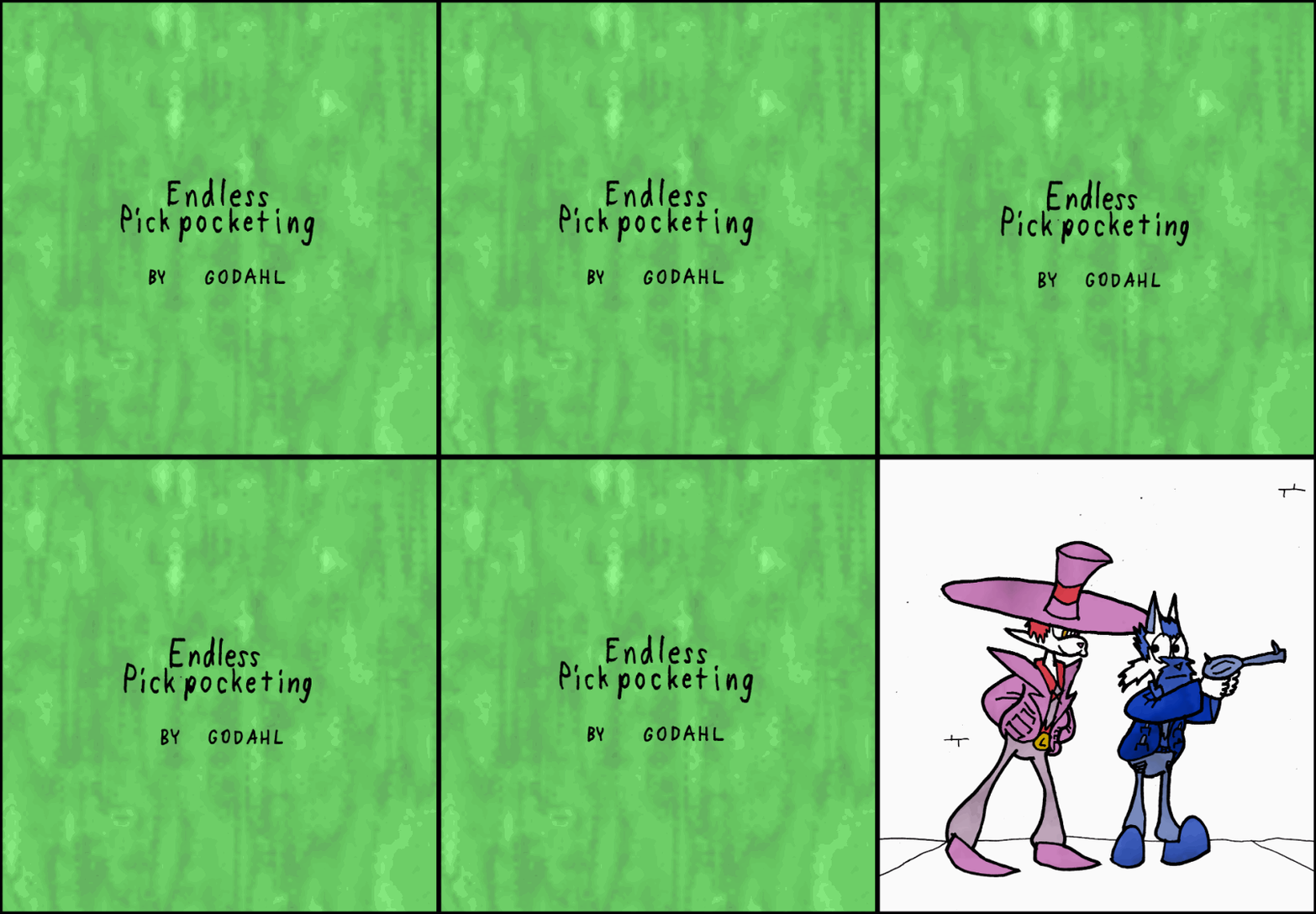
This is Endless Pickpocketing, by Eri Godahl Drury. Click the image above to make a daring robbery attempt on your target. Watch his eyes to make sure he doesn’t see you do it!
This page is fairly inaccessible to screenreader users, I’m sorry to say. It also runs pretty badly on Firefox, and I don't really know why. Again, sorry.
That being said, okay. Let's talk.
Imagine this: The year is 2024. I’ve just moved into a new apartment, and I’m over half a decade into the “Lizzie Smithson” project, a series of card games, comics, and videogames attempting to recreate the childlike wonder I spent as a teenager playing Sly Cooper on the Playstation 2. I’m at work at the grocery store, cutting cheese, when an idea for a small game hits me out of the blue. It’s a simple game, only vaguely similar to the games that inspired me, but it’s achievable! I’m a good enough artist and programmer to bring it to life! Over the rest of my work shift, my mind plugs away at the idea, working out how much art I’d need, solving, in theory, the design issues I can imagine having with it, and thinking of how cool it would be to play. I finish work, go home, pull out my sketchbook, and draw all of the lineart the game requires–about four pieces worth, of two characters per piece, with various drawovers intended to be edited into simple animations. Over the course of the rest of the week, I scan the drawings, color them, animate them, write all the code, and eventually I’m staring at a finished game, idea phase to “shippable product” in about as much time as it takes to recover from an all nighter (don’t fact check this, I’m on a roll).
And I hate it.
I feel embarrassed about the game, self conscious about its sheer lack of scale and scope. The previous week, I had put on the Quinton Reviews breakdown of the 2000s era licensed game series “Nicktoons Unite” (2005) in the background while I did other things–so those games were on my mind, and I couldn’t help but think Endless Pickpocketing, the game I’d just made, didn’t measure up. Like, it wasn’t *even* as good as this cobbled together corporate barely finished mashup slop for toddlers. Endless Pickpocketing wasn’t even on that level!
So I tried to work out what could make the game more valuable–the best I could come up with, was to write a short essay describing my frustrations with the game’s weaknesses, in simultaneous semi-ironic self-deprecation and genuine apology, that I would record as an audio essay and set to play in the background while the game ran. I wrote the essay, recorded it, embedded it into the HTML file, and uploaded the game to my Neocities, and that was that. I was a failure, but at least I could admit to my shortcomings. The game was out in the world, and I could move on with my life.
And then, a funny thing happened. I kept playing Endless Pickpocketing. I would navigate to its page on my phone during idle moments at work. If I had nothing better to do, and I also was making a conscious effort to stay off of social media, which is bad for me, there was always Endless Pickpocketing, ready to bite off a few pleasant minutes of my life. Something about the game really clicked for me during this period–I showed it to a few friends, one of whom described it as “not good, but addictive,” and I continued to play it. It entered my regular rotation of games I would play, landing under my fingers about as often as, yes, Sly Cooper. Or Paper Game!
Why is that? Well, I can name a couple of reasons. For one, it kind of satisfies the same urge to endlessly grind at getting higher numbers that I felt in its inspiration, Sly Cooper 3. I can play Sly 3 for hours, picking pockets to get more and more money, and Endless Pickpocketing is a neat minimalist approximation of that experience (it doesn't affect my happiness that my score resets to zero when I mess up). It doesn’t really match the sort of emergent gameplay, the sort of chance happenings that occur constantly when you run around endlessly picking pockets in Sly 3, but it gets the broad strokes.
For second, Endless Pickpocketing is an entry in my continuous exploration in hopes of finding a truly “infinite” playable fidget toy–the experiment goes as thus: “Canabalt” (2009) is an endless runner, and so a session of that game lasts until you die. However, when you DO die in Canabalt, the game stops. You have to actually tap the screen to continue playing. There’s a break in the action, the game gives you the opportunity to put the game down, never touch it again, delete it from your phone. So I was thinking, well, what if it didn’t do that? If Canabalt restarted from the beginning every time the player died, withOUT player input; would it still be good? Would anybody want to play it? Is it unethical design? Is it unpolished-feeling in an unacceptable way? Why don’t people design these sorts of games this way? Whatever the reason, well, why shouldn’t I?
Endless Pickpocketing answers that question thoroughly, to the point of not even needing a pause screen (You can just walk away from your computer, grab a drink, return to continue picking pockets, and lose zero progress). When my friend described it as “not good, but addictive,” I think this is what he meant. It’s a dirt simple game, a *bedrock* simple game–and yet it flows like water.
In the original essay I wrote to accompany this game, I groaned that I wanted to make “bigger” games, make something more ambitious, more scopeful. Well, I finally made a game that sort of satisfies that need (Pickpocket TV), and I’m working on making a game where you can actually move a character around a screen, so that’s an ambition I’m working on satiating. But I still play Endless Pickpocketing, once in a while, plugging away at my score, shrugging off my defeats, and the game has stayed with me this past year and a half. It would be nice if it stayed with me for the years to come, but who knows.
Anyway, it’s okay. Seven out of Ten.